Strategic grants management

Grants management functional areas

A strategic grants management function includes at least one dedicated grants management professional in a leadership position who is running a centralized function that performs all of the core grants management responsibilities and activities.

1892 consulting’s strategic grants management model catalogs all of the core grants management responsibilities and activities that a foundation typically performs across seven functional areas.

It is essential to have all of these activities centralized under the grants management function to allow the team to provide high-touch and continuous service across the entire grant lifecycle. In addition, the full integration of this work within the grants management function ensures that a grants management professional who identifies process bottlenecks or system issues can also craft and implement thoughtful and holistic solutions.
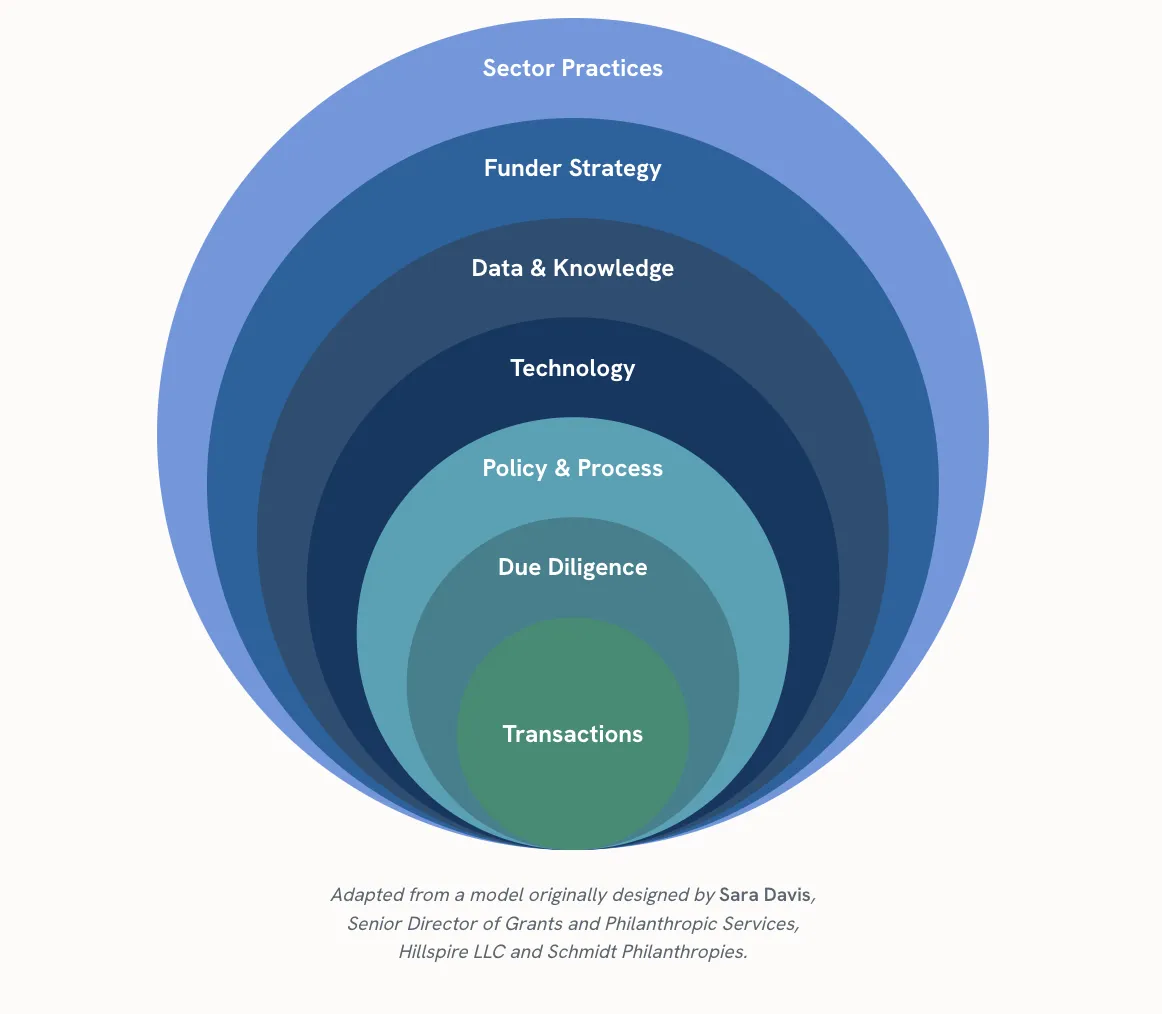
Concentric-circles model of the seven grants management functional areas, from Sector Practices on the outside in to Transactions at the core.

Grants management functional areas

It is essential to have all of these activities
centralized under the grants management function.

A grants management team can work across all seven functional areas simultaneously. For example, they can both process grant payments (Transactions) and also stay up-to-date on Trust-Based Philanthropy (Sector Practices). That said, we see the functional areas as somewhat hierarchical, meaning a foundation needs to have robust “Technology” in place before they can become proficient in “Data & Knowledge”.

While a funder may not perform all of these activities and might do so at different levels, these activities are most strategically aligned when centralized under the grants management function.

Functional areaFramework definitionExample in practice
Sector PracticesEngage with institutions, communities, and industries to gain insights and share learning on innovative practices that inform efficient, effective operations.Attend a webinar on responsible AI in philanthropy.
Funder StrategyAdvise and collaborate across internal teams to develop, shape, and implement the funder’s grantmaking priorities and activities.Participate in a program area meeting to discuss launching an open call for proposals.
Data & KnowledgeAnalyze and disseminate robust grantmaking data and information to contribute to the funder’s knowledge management practices.Create a dashboard to track workflows for a new portfolio or program area.
TechnologyLeverage technology to support the complete grantmaking lifecycle, and continually ensure systems are responsive to evolving needs.Design, build, and test new grantee bank account collection portal features.
Policy & ProcessDevelop and maintain grantmaking policies, processes, and tools to advance the funder’s grantmaking approach and strengthen partner relationships.Update internal and external guidance around indirect costs.
Due DiligenceAffirm the funder is in compliance with applicable laws and regulations while advocating for grant structures that foster trust and transparency.Confirm fiscal sponsorship for a new potential grantee.
TransactionsEnsure the funder’s financial resources are redistributed to communities by accurately and expeditiously processing and paying grants.Send out a batch of award letters and coordinate with Finance to process payments.

Contact us to learn more about strategic grants management, and check out our tool to design the ideal grants management team.

How our model came to be

Back in 2019, our first version of the model was primarily an organized list of all the tasks grants management professionals perform to award and pay grants. As we reflected on the work we had owned as grants managers and had supported as consultants, we added systems, data analytics, training, and process redesign. To help foundation leaders visualize the gap between their current and aspirational grants management functions, we also incorporated a diagram on the “Evolution of Grants Management” developed by Sara Davis, Senior Director of Grants and Philanthropic Services at Hillspire LLC and Schmidt Philanthropies.

Over the years, we have used this model with foundation clients, adding in staff roles to show when several people across different teams were performing the same task as well as to highlight when critical responsibilities were altogether absent. The model also helped us advocate to foundation executives when they needed to hire a leader to guide the strategy and direction of the function and manage a centralized team.

Our model further evolved through conversations with Indya Hartley (Senior Director of Grants Management at the Robert Wood Johnson Foundation), Kelly Costello (Director of Grants Management at Rose Community Foundation), and Kelly Hayashi (Director of Grants Management at Heising-Simons Foundation), who joined Rebecca Van Sickle in a small working group coordinated by PEAK Grantmaking. They provided valuable feedback, edits, and reflections based on their day-to-day experiences as grants management professionals. Kelly Hayashi also helped us make an important connection between Sara Davis’ original diagram and the numerous grants management tasks that our 1892 team had documented. Nancy Herzog (Vice President of Grant Operations and Evaluation at National Endowment for Democracy) and Dan Gaff (Director of Grants Management at May & Stanley Smith Charitable Trust) helped emphasize the role of grants management in setting foundation policies. Cristina Yoon (former Senior Director of Grants Management at Skoll Foundation) provided endless counsel and guidance throughout this entire project.

Thank you to all of our friends and colleagues who have provided ideas and support throughout the years!